
The US Inflation Reduction Act: Mechanisms, Global Impacts, and Future Risks
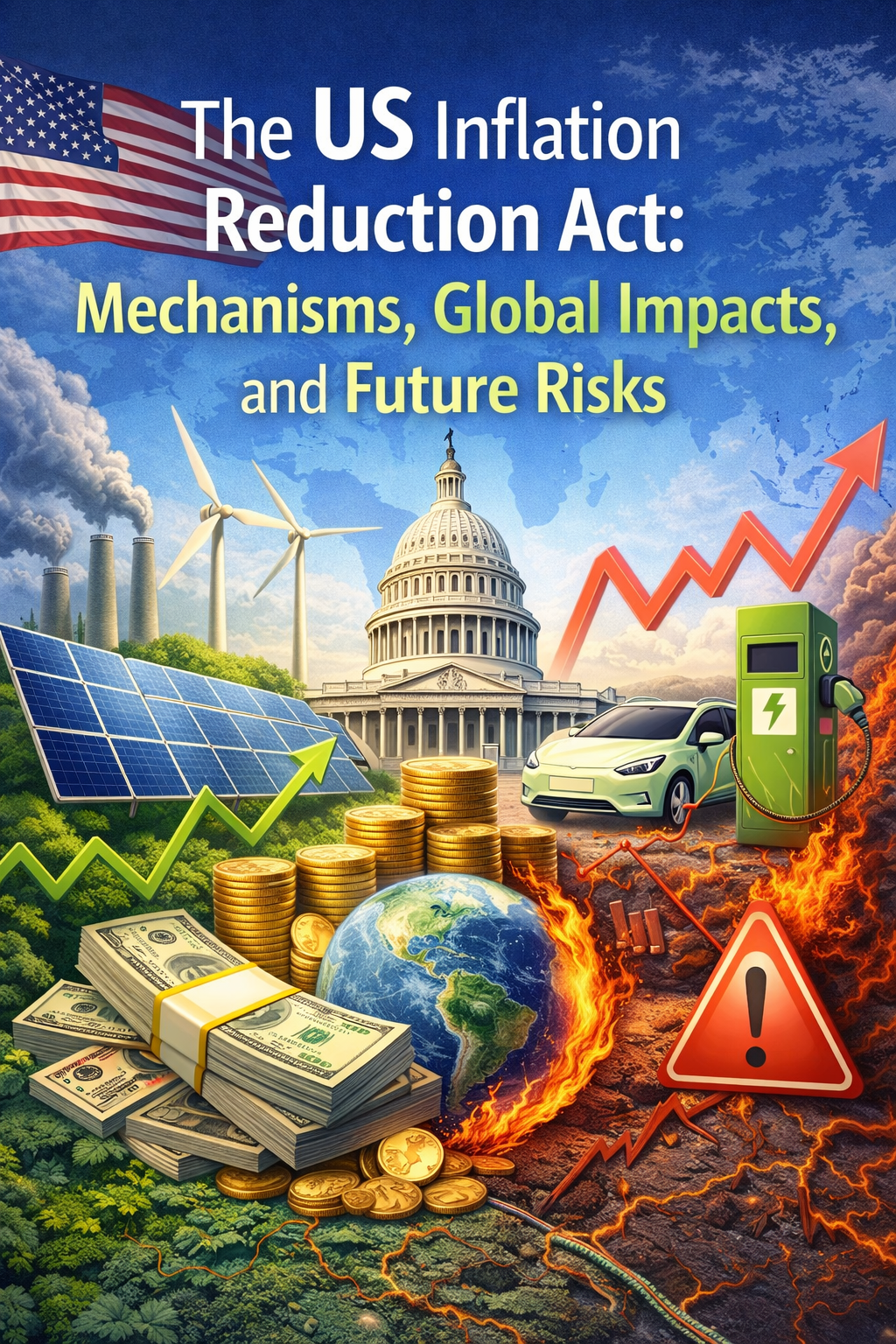
The Inflation Reduction Act (IRA), signed into law in 2022, represents the largest single investment in climate and energy in United States history. While the name suggests a focus on monetary policy, the legislation functions primarily as a sweeping industrial and climate policy package, allocating approximately $400 billion to accelerate the transition to a clean energy economy.
For sustainability professionals and observers, understanding the IRA requires looking beyond the headline figures. This analysis explores how the policy functions, how it differs from international counterparts, and the potential risks facing its continuity.
1. The Mechanism: An Incentive-Based Approach
Unlike climate policies that rely on carbon pricing or strict regulations (often referred to as “sticks”), the IRA operates almost exclusively through incentives (“carrots”). The goal is to lower the cost of green technology to make it competitive with fossil fuels.
The legislation utilizes three primary tools:
- Tax Credits (ITC and PTC): The law extends and expands the Investment Tax Credit (ITC) and Production Tax Credit (PTC). These allow businesses and individuals to deduct a percentage of the costs for renewable energy projects, such as solar, wind, and battery storage, from their federal taxes.
- Direct Pay (Democratization of Access): A significant innovation in the IRA is the “Direct Pay” provision. Previously, tax credits were useless to entities that did not pay federal taxes. Now, non-profits, local governments, universities, and tribal organizations can receive these credits as direct cash payments.
- Example: A public university installing a solar array can now receive a direct reimbursement for ~30% of the project cost, making renewable energy financially viable for the public sector.
- Risk Reduction (Loan Guarantees): The Department of Energy’s Loan Programs Office (LPO) received expanded authority to act as a guarantor for large-scale energy projects. By backing loans for innovative technologies (like clean hydrogen or advanced nuclear), the government assumes the risk, encouraging private capital to invest in technologies that commercial banks might otherwise consider too experimental.
2. Impact on Supply Chains and Manufacturing
The IRA includes “local content” requirements, meaning that to qualify for full subsidies—particularly for Electric Vehicles (EVs)—a certain percentage of minerals and components must be mined or manufactured in the US or free-trade partner countries.
Research indicates this has created two distinct effects on the global supply chain:
- Relocation: International battery suppliers and manufacturers are moving operations to the US to access these subsidies and avoid tariffs.
- R&D vs. Production: While subsidies successfully boost local manufacturing volume, economic models suggest that without specific support for Research & Development (R&D), companies may prioritize scaling existing technologies over developing newer, more efficient ones.
3. Comparative Analysis: The IRA vs. The EU Green Deal
When viewed through a comparative lens, the IRA differs structurally from the European Union’s Green Deal. Understanding these differences highlights the specific focus—and limitations—of the US approach.
- Scope of “Green”: The EU Green Deal incorporates a broad range of environmental pillars, including biodiversity protection, “Farm to Fork” sustainable agriculture, and the circular economy (waste reduction). The IRA, by contrast, is narrowly focused on energy production and carbon reduction.
- Circular Economy: The IRA lacks robust mechanisms for end-of-life management (recycling) of the technologies it promotes.
- Regulatory Framework: The EU uses a mix of regulations and carbon taxes. The IRA relies on market stimulation, avoiding federal mandates or carbon pricing.
4. Future Outlook and Risks
The sustainability of the IRA itself is subject to political stability. Independent analyses suggest that the legislation has placed the US on a trajectory to reduce greenhouse gas emissions by approximately 40% by 2030. However, this progress is not guaranteed.
Potential risks to the policy’s continuity include:
- Policy Reversal: Changes in administration or legislative priorities could lead to the repeal or weakening of funding mechanisms.
- Investment Uncertainty: If global investors perceive US climate policy as volatile or temporary, the flow of private capital—which has been catalyzed by the IRA—could slow down.
- Emission Targets: Estimations show that dismantling the IRA could limit US emission reductions to roughly 28% by 2030, significantly missing international targets.
Conclusion and Policy Implications
The Inflation Reduction Act is a formidable tool for deploying clean energy infrastructure and stimulating domestic manufacturing. However, from a holistic sustainability perspective, it functions more as an energy and industrial policy than a comprehensive environmental framework.
To ensure long-term success and global alignment, the following policy adjustments are recommended:
- Enhance Regulatory Certainty: Long-term legislative guarantees are needed to protect climate investments from political cycles.
- Broaden the Scope: Future policies should integrate circular economy principles to manage the waste generated by the renewable energy transition.
- Support Innovation: Incentives should be balanced between mass production and R&D to ensure continuous technological improvement.
- International Cooperation: Trade policies should be harmonized with allies to prevent supply chain inefficiencies and promote global adoption of green technologies.
🟢 Next Step for the Reader
Assess Your Eligibility: The IRA offers opportunities that are often overlooked by smaller entities. We encourage readers in the US to consult the Database of State Incentives for Renewables & Efficiency (DSIRE).
- Action: Check if your organization (whether a business or a non-profit) qualifies for “Direct Pay” or specific tax credits for energy efficiency upgrades, such as heat pumps or insulation, which are now subsidized at higher rates.
References:
- EPA. Summary of Inflation Reduction Act provisions related to renewable energy.
- DOE Loan Programs Office. Inflation Reduction Act of 2022 & Title 17 Clean Energy Financing.
- Evans, X., et al. (2025). The US Inflation Reduction Act: Is it a Green Deal? Sciences Po.
- Asuene. (2025). What happens if the Inflation Reduction Act disappears? Global Implications.
- Zhang, L., & Shi, W. (2025). The Impacts of the US Inflation Reduction Act on EV Supply Chains. Sustainability, 17(2).
I really enjoyed reading your article! I find this step very valuable.